 TEXAS ATOMICS
TEXAS ATOMICS
TEXAS ATOMICS
Texas Atomics is licensing a proven molten salt reactor for the United States, a design that has already been built and tested. It runs hotter, holds itself stable, and can produce the isotopes used to treat cancer alongside firm, carbon-free power.
U.S. reactors run at roughly a 93% capacity factor, the highest of any energy source. It is the steady baseload a reliable grid is built on.
A fingertip-sized uranium pellet releases about the energy of a ton of coal. That is enormous output from a land and fuel footprint a fraction of any alternative.
Fission releases no carbon dioxide in operation, and nuclear sits among the lowest lifecycle-emission sources ever measured.
U.S. electricity demand is climbing for the first time in two decades, driven by data centers and electrification. Nuclear is the only carbon-free source that adds round-the-clock power at gigawatt scale.
Run the fuel as a liquid and a reactor can do far more than make electricity.
Nuclear fuel is dissolved into a fluoride salt, so fuel and coolant become a single circulating liquid. There are no rods, cladding, or pellets that can crack, swell, or fail.
The salt circulates through the core at roughly 700°C, far hotter than a water reactor. That temperature drives turbines efficiently and can supply process heat to heavy industry directly.
As the fuel salt warms it expands and thins, which slows the reaction. This negative temperature feedback makes the reactor self-regulating rather than something that must be actively held in check.
At the base of the core sits a plug of frozen salt, kept solid by nothing more than a small cooling fan, a mechanism first demonstrated at Oak Ridge in the 1960s.
If power is ever interrupted, the plug melts and the fuel settles by gravity into tanks shaped to hold it at rest. No operator action, no pumps, no backup generators. Because the safety comes from the design itself, these reactors can be built smaller and sited closer to where the power is needed.
To make it safe, you don't add anything.
You take the power away.
Targeted radiopharmaceuticals attach a radioactive isotope to a molecule that seeks out cancer cells, delivering radiation directly to the tumor while largely sparing healthy tissue. The clinical results have pulled billions of dollars into the field, and pushed demand straight into a supply chain that cannot keep up.
Most reactor-produced medical isotopes come from a small number of government research reactors, many over fifty years old and most of them overseas. A single unplanned outage has repeatedly caused global shortages.
The most promising therapeutic isotopes are the scarcest. Global actinium-225 output is commonly described in thousands of doses per year, against demand measured in patients per week. Clinical trials are constrained by supply, not by science.
Conventional production fabricates a solid target, irradiates it, waits for a shutdown, disassembles it, and ships it. The batch cycle is measured in weeks, for isotopes whose half-lives are measured in days.
The United States is the largest market for radiopharmaceuticals and remains heavily dependent on imported, reactor-produced isotopes. It is a supply-security problem federal programs have flagged for over a decade.
Because the fuel in a molten salt reactor is a liquid, isotope production stops being a batch process. Target material is dissolved directly into the salt, and the isotope is chemically separated from a side stream while the reactor runs: no target fabrication, no shutdowns, no disassembly. Short-lived isotopes are harvested fresh, on a schedule set by the pharmacy rather than the refueling outage.
The Alamo 1 reactor is designed to demonstrate this capability on U.S. soil, under a U.S. license. It is the foundation for a domestic, continuous, reactor-based isotope supply. We are engaging now with biopharma and radiopharmaceutical partners on isotope demand, separations chemistry, and long-term supply agreements.
A reactor that ships isotopes while it runs.
The molten salt reactor is not a paper concept. It ran at Oak Ridge National Laboratory from 1965 to 1969, where the Molten-Salt Reactor Experiment logged thousands of hours of full-power operation and demonstrated the core idea: liquid fuel, low pressure, inherent stability. The physics held; federal funding consolidated around the light-water reactors already in commercial service, and the program was shelved. Sixty years later, demand for firm clean power is back, and for the first time a modeling toolchain validated against a live reactor makes the design licensable.
Texas Atomics is a full-stack molten salt reactor developer. We combine reactor modeling validated against a real operating reactor with a proven hardware platform, and carry a reactor from design through licensing into operation.
Because the fuel is a liquid, the same reactor can also produce medical radioisotopes, used in targeted therapies that deliver radiation directly to cancer cells while largely sparing healthy tissue.
Our first project, the Alamo 1 reactor, is a demonstration facility in Texas, advancing through the U.S. Department of Energy's NRIC Nuclear Energy Launch Pad. Its purpose is to prove that Texas Atomics can license and operate this technology in the United States. See how our reactor works →
Our reactor
Rather than design a power reactor from scratch, Texas Atomics is bringing Copenhagen Atomics' Onion Core®, a containerized molten salt reactor with roughly a decade of hardware testing behind it, to the United States under a U.S. license, currently in advanced negotiation.
Copenhagen Atomics has spent roughly a decade proving the Onion Core®, with thousands of hours of salt-wetted hardware testing behind it. Texas Atomics' role is to deploy that technology domestically: securing the U.S. license, building and operating the reactor here, and standing as the domestic owner-operator that U.S. nuclear law requires.
The reactor is already built and tested. We bring it to America and get it licensed.
Instead of the bundles of solid fuel rods in a conventional reactor, the Onion Core® is built from nested layers wrapped around a center. Two liquids do two jobs: one salt makes the power, the other breeds new fuel. From the inside out:
An inner core of heavy water (D₂O) moderates neutrons, sitting near ambient temperature and atmospheric pressure.
LiF–UF₄ fuel salt, beryllium-free with enriched lithium-7, circulates here at roughly 600–700°C. This is where fission happens.
A second D₂O layer wraps the fuel salt, shaping the neutron spectrum and carrying heat away from the core.
An outer ThF₄ salt captures escaping neutrons and breeds new fuel.
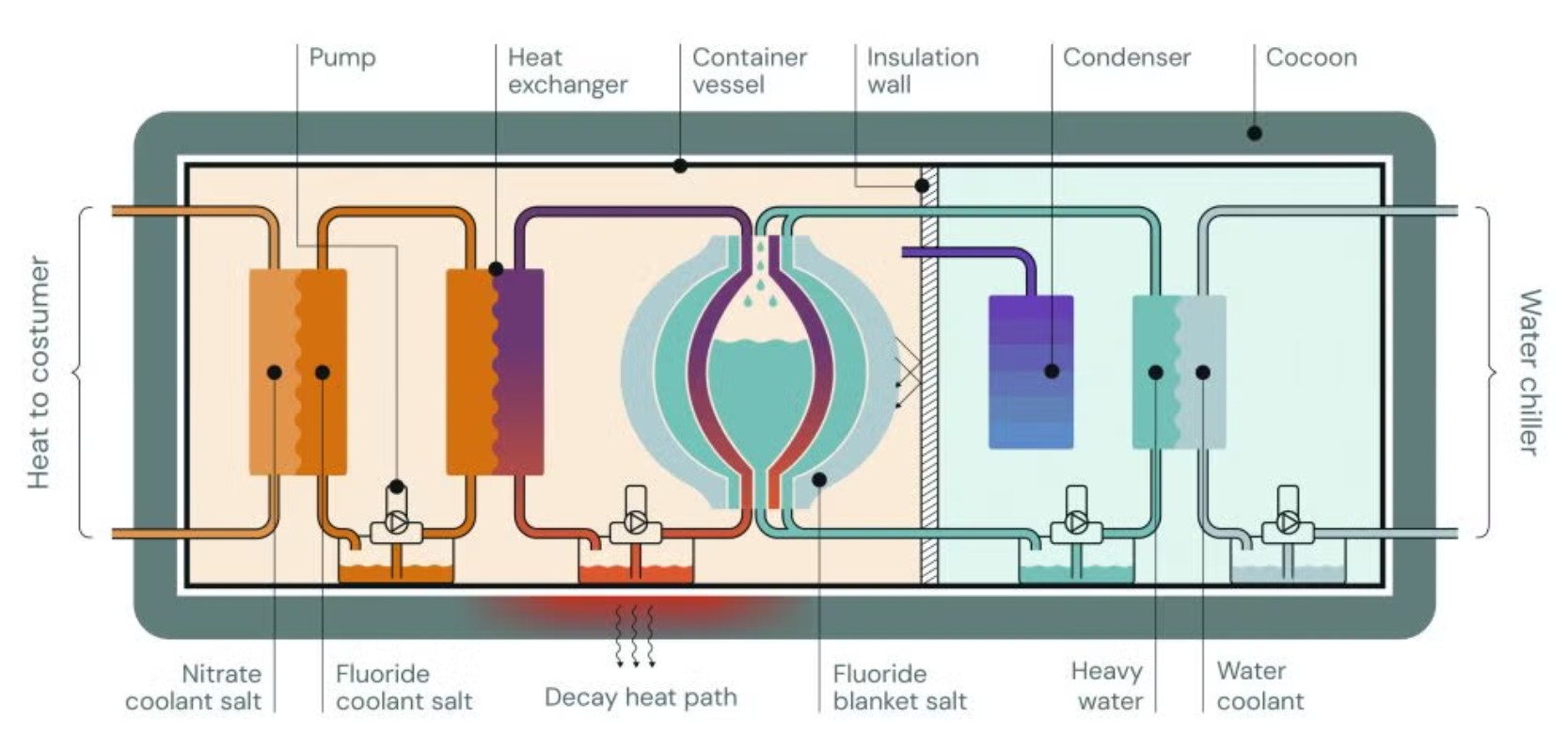
Alamo 1 is a molten salt demonstration facility, with no electrical output, planned for Texas. Its purpose is to prove that Texas Atomics can license and operate this technology in the United States, and to exercise the company's full-stack capability end to end.
The reactor's own fission keeps the salt molten: no external heaters, no power-conversion system, no pressurization.
Fueled by low-enriched uranium that is commercially available today, dissolved into salt with none of the fuel-rod fabrication a conventional reactor requires.
The heavy-water layers sit near ambient temperature. Stop fission and the salt simply freezes in place, the benign end state.
Alamo 1 takes the design from paper to a running, licensed reactor, validating the modeling, the fuel, and the operations the larger power reactors will be built on.
Alamo 1 proves the licensing and operating path. The same platform is designed to scale: Copenhagen Atomics' commercial Onion Core® is a 100 MWth reactor delivering firm, carbon-free power for the grid and for behind-the-meter industrial sites. Texas Atomics is built to be the U.S. owner-operator that deploys it here.
Because the fuel is a liquid, the same reactor can also produce medical isotopes: target material is dissolved into the salt and the isotope chemically separated from a side stream while the reactor runs, rather than through a fuel-rod fabrication, irradiation, and disassembly cycle.
Texas Atomics pairs two capabilities that rarely sit in one company: reactor modeling validated against a real operating reactor, and a hardware platform with a decade of test data behind it. The team is built from the people who demonstrated each.

Dr. Ross is a computational nuclear engineer and the technical foundation of Texas Atomics. Through the University of Texas at Austin's Digital Molten Salt Reactor Initiative, his doctoral work produced a validated digital twin of UT Austin's research reactor: a working demonstration that a molten-salt-relevant multiphysics model can be anchored to real reactor data and trusted as a basis for analysis and licensing.
He carries that capability directly into the company, where the same methods now model Texas Atomics' own reactor. It is the difference between a simulation a regulator must take on faith and a model proven against the reactor it describes. Dr. Ross leads technical direction, research partnerships, and capital formation.

A senior corporate-finance leader across the healthcare and life-sciences industries. He is currently SVP of Finance at Fagron, with prior CFO roles and senior finance leadership at St. Jude Medical, Thermo Fisher Scientific, and Cardinal Health. He owns financial management, the milestone-based funding structure, and investor relations.

Principal at StoneCreek Capital Partners with deep commercial real-estate and land experience. Also Executive Director and Chief Investment Officer of Miteff Group Ltd., overseeing a diverse portfolio of industrial, retail, and residential properties alongside oil & gas working-interest investments. He leads site control, commercial partnerships, and land development for the future fleet of molten salt reactors.
Texas Atomics runs lean and integrates two external groups, holding single-point accountability to its regulators across both.
University of Texas at Austin provides the validated digital twin, independent physics verification, and experimental separations research, via sponsored research.
Copenhagen Atomics supplies the Onion Core reactor.
Born in Texas · Built for the world